Happy Yule everyone!
What’s Yule you ask?
As most of you know, December is the most wonderful time of the year; full of peppermint, sparkly lights, and general, all round cheer. But did you know that in addition to Christmas there exists another holiday where a lot of Christmas traditions derived from? Yule!
Yule is a pagan holiday typically celebrated in junction with the Winter Solstice on December 21st. It is meant to be a holiday of feasting and relaxation to give thanks to having a great year and spending time with the people in your life. It represents what in ancient Rome was considered the Age of Gold, a time when things were completed and it was time for relaxation. There was no need to plow because it was a time for rest and feasting before the transition into the Age of Silver in spring when the cycle would continue, starting over at the beginning.
One of the oldest influences to Yule was Saturnalia, the Roman holiday to Saturn, the god of agriculture. Romans would use this holiday to give thanks for the bountiful harvest from the year and enjoy what they had sown. Additionally, from an astrological standpoint, Saturn represents the limitations in life and acts as a mentor and teacher; one whose lessons are manifested over time, finally coming to fruition, like all the hard work and harvest of the year. Then, a few days later, it is said that the infant god Mithras was born on the 25th of December, creating yet more reason for celebration in Roman society. Also setting the precedent for the concept of “rebirth” and “birth of an infant god” that carried over into Christianity and Christmas.
A couple more influences to present day Yule were the traditions of the Norse. The Norse celebrated Yule from December 21st all the way to the beginning of January. In fact, the origin of the idea, the “12 Days of Christmas”, most likely came from the fact that in Norse tradition, Yule is a 12 day holiday; starting with “Mother’s Night” and ending with “Yule Night”. More specifically broken down the 20th-23rd are when the virgin maiden is celebrated, the 23rd-26th is for the mother goddess, the 26th-29th is dedicated to rebirth, and finally the 29th-1st is the time of the old crone. But overall, throughout all traditions in all places, Yule has always been a festival of rebirth, midwinter, the shortest day of the year, and the longest night.
On top of the origins of Yule being adopted to become a part of the Christmas we know and love, some of the Christmas traditions that are practiced today come from Yule as well. The colors of white, green, and red that are used in Christmas decorations come from the colors of Yule that were inspired by the Holly Tree and the Christmas tradition of hanging mistletoe also originates from a pagan background. Mistletoe was considered a symbol of everlasting life because it remained green throughout the entire year and was hung in homes and doorways to ward off evil.
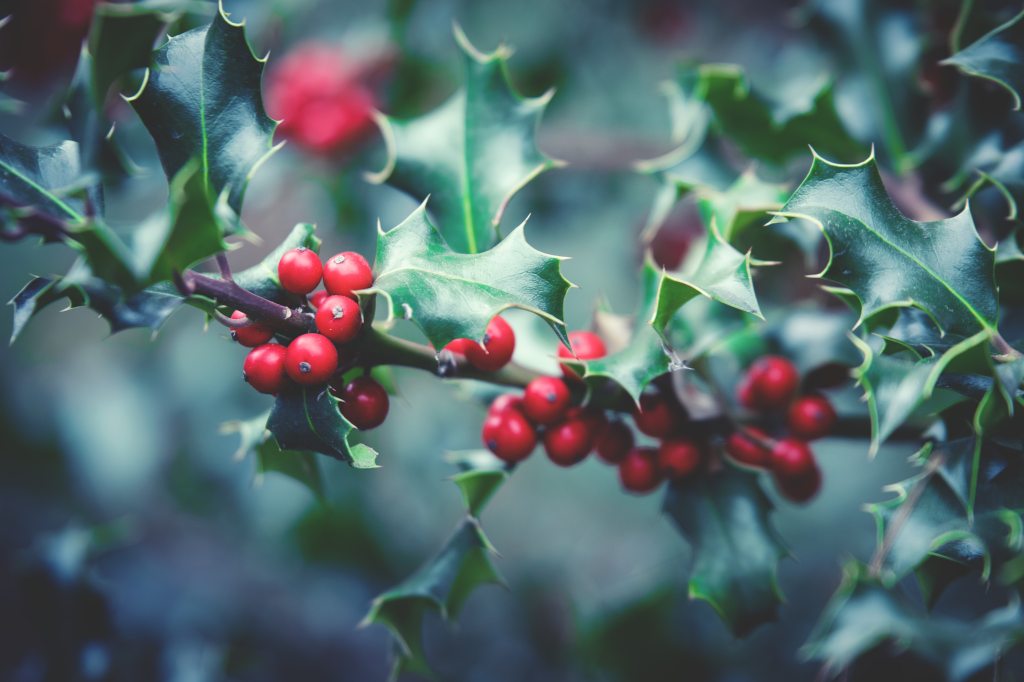
On a similar note to the mistletoe, the evergreen tree was considered to be a symbol of life and protection but the tradition of bringing an entire tree into one’s home for the seasons was oppositely, not an inherited one from pagan roots but rather something that came into being in Germany in the 16th century. However, while taking a whole tree was considered far too destructive for your average witch or druid, during Yule, people would cut boughs of trees and bring them into their home for decoration. Hence the lyric, “deck the halls with boughs of holly.”
Another Yule tradition is the Yule Log which was originally meant to be used sacrificially to thank the gods for a good year. The log was never meant to be purchased from a store but rather gifted from one family to another or found in the woods and at the end of the night, the remaining pieces of the log were put away to start the fire for next year. Additionally, the ashes from the log were thought to be protective and would be both scattered on the property and used in protection spells throughout the year.
Overall, Yule today is a magnificent conglomeration of traditions and lore from many different cultures that have come together to celebrate the winter solstice and give a salute to the year as the wheel turns again back to the beginning. If you’re not doing anything on the 21st, maybe light a candle and give a nod to the universe as thanks for the year.
 Chelsea Hoel - Freelance Writer