Well, here goes nothing.
According to the CDC (Center for Disease Control) and the WHO (World Health Organization), this particular strain of coronavirus originated from Wuhan, China and spread from there. Despite the confusion surrounding what the disease itself has been called, this is NOT the first known disease casued by the coronavirus. CoV or coronavirus is a large family of zoonotic diseases; meaning they are transmitted between animals and humans. This particular strain of coronavirus is what is known as COVID-19 and while all COVID-19 are coronavirus, not all coronavirus are COVID-19. Other coronaviruses include SARS (Severe Acute Respiratory Syndrome), which was transmitted from covit cats to humans, and MERS (Middle East Respiratory Syndrome), which was transmitted from camels to humans. So are they all related? Yes, but in the same way that your cat ‘Roger’ is related to lions.
On January 30, 2020 the International Health Regulation Emergency Committee of WHO declared that COVID-19 was a “public health emergency of international concern” and declared it a pandemic. While that may sound scary, all it means is that it’s a global outbreak of disease, meaning that there are people exhibiting symptoms everywhere instead of one particular country or region. This is largely due to the fact that coronavirus is not deterred by climate or weather changes like some other diseases; so it doesn’t matter if you live in the desert or a swamp, there will be a similar number of cases in the long run.
The risk levels of catching COVID-19 are largely the same as other diseases of similar contagiousness. Your personal risk of being exposed to COVID-19 is rather low right now in most places but will get higher as the outbreak continues. It’s estimated by the CDC that in the next couple months, most of the US will be exposed to the virus. However, that doesn’t necessarily mean that the deaths or hospitalizations will rise exponentially. Additionally, risk will begin to decline after a while once herd immunity is built up again and medication and vaccines are developed.
In most of the cases, especially with children and young adults, the symptoms are mild and do not require hospitalization. However, as with any type of illness there are going to be people who are more susceptible to the symptoms putting them in the hospital. With COVID-19, the susceptible individuals, the people most likely to be the 1 out of 5 people ending up in the hospital from the disease are people with heart or lung disease, diabetes, and older people. Most other people will either just be at home sick for about a week or so or may not even feel ill at all.
To put it into context I’d like to compare it to the seasonal flu. With the seasonal flu, not only are people with heart or lung disease, diabetes, and older people at risk for getting sick and ending up in the hospital, but so are pregnant women, children ages 5 or younger, and people who care for or live with children. Additionally, since the COVID-19 outbreak in China there have been a reported 153,527 cases and 5,733 deaths worldwide (you can watch the numbers yourself on this map here provided by the WHO). Even if we assume that these numbers are only from January to now (which we can assume that they are not), we are seeing an average of about 1,911 deaths a month from COVID-19 worldwide. Comparatively, since October of 2019 we have seen somewhere between 12,000 and 30,000 deaths and 210,000 – 370,000 hospitalizations from the seasonal flu; giving us between 2,000 and 5,000 deaths a month.
In 2018-2019 it was estimated by the CDC that 35,520,883 people would catch the seasonal flu and exhibit symptoms. When comparing that number to the 153,527 cases thus far worldwide through COVID-19, the number of people affected would need to increase by nearly 3 million people a month to even come close. It is true that things tend to get worse before they get better, but seeing that cases in China are reaching a plateau at about 81,048 cases, it’s highly un likely that it will even begin to touch seasonal flu numbers.
So, if it’s not as much of an issue as the seasonal flu numbers-wise, why is everyone freaking out? Because it’s new. People inherently have a fear of the unknown and since it is so new, scientists have not discovered a vaccine for it yet. Coronavirus strains are tricky because since they aren’t bacteria, antibacterials and antibiotics won’t do anything except deplete your good, internal bacteria. However, according to research reports and papers published by the WHO and CDC, scientists are currently running experiments and conducting tests not only to create a vaccine for this particular strain of coronavirus but also are testing cross-reactivity of vaccines and medicines used to treat other strains such as SARS or MERS.
Long story short, don’t panic, wash your hands, maintain enough of a distance from people that you won’t breathe in their spray if they sneeze, and only wear a mask if you’re already sick. COVID-19 is not an airborne illness, so wearing a mask if you’re not sick is only going to take supplies from people who need to cover their mouths as to not infect other people and individuals in healthcare who are at risk of being sneezed on 24/7. While we are on the subject of taking supplies from people who need them, part of the reason that such a problem is being created by COVID-19 is because people *cough cough* keep hording *you know who you are* toilet paper and cleaning supplies. Karen, if you have all the rubber gloves, where are the hospital staff going to get them? Do you want to be personally responsible for people dying due to lack of supplies in a hospital?
Now, I’m not saying don’t keep 30 days of supplies like the CDC suggests, but don’t hoard a years worth of toilet paper and clorox wipes. Part of flattening the curve, infographic seen below, is making sure that healthcare professionals have the capacity to care for the number of people coming in. If they don’t have the supplies they need, that number of people they can care for will be significantly lower. The last thing you’d want is to hoard supplies, get sick, go to the hospital, only to find out that you purchased the last of the supplies. “I have some at home.” Well you can’t leave the hospital Karen, fat lot of good that does you now.
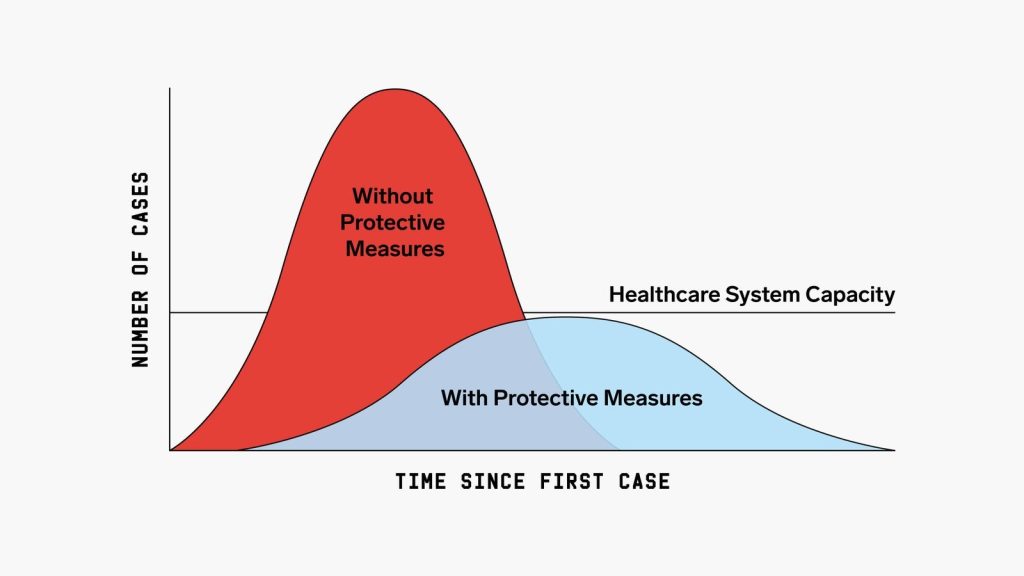
There are a lot of sources of information out there about what’s going on that are not tainted by the media. So on top of taking care of yourself, seeing a doctor if you feel sick, and being cautious, another good move might be to stop consuming media that causes panic. Look for your information through reputable sources like WHO or the CDC, links below. Take care of yourself and remember that the less we all panic, and the more we let healthcare professionals and scientists do their jobs, the less of an issue this will all be.
https://www.who.int/health-topics/coronavirus
https://www.cdc.gov/coronavirus/2019-ncov/index.html
Stay informed and stay safe kids!
 Chelsea Hoel - Freelance Writer